Thursday, November 17, 2016

Questions and Numerical problems on Bending Stress

Bending Stress

1. Define pure bending along with neat sketch
2. State the assumptions of simple bending
3. Define section modulus and also derive the equation for the same for rectangular, circular, triangular, hollow rectangular and hallow circular sections.
4. Derive the expression M/I=f/y=E/R
5. Define moment of resistance and neutral axis.

Problems on bending stress
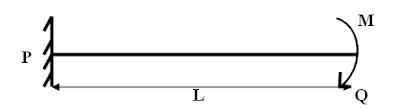
1. A cantilever beam of length 2m fails when a load of 2KN is applied at the free end. If the section is 40mmx60mm, find the stress at the failure.

Solution:
Step 1: Data:
Length of beam = 2m or 2000mm
load at failure = 2KN
Section dimensions = 40mm X 60mm

Step 2: Calculation of moment of inertia
I = bd3/12
  = (40) (603)/12
  = 7.2X105 mm4

Step 3: Calculation of bending moment about fixed end
M = WL
    = (2)(2)
    = 4KN-m

Step 4:
Calculation of bending stress
M /I= σ / y
Substitute for above (where y = depth /2= 60/2 = 30mm)
There fore 
σ = 166.67N/mm2

2.A rectangular beam 200mm deep and 300mm wide is simply supported over the span of 8m. What uniformly distributed load per metre the beam may carry, if the bending stress is not exceed 120N/mm2.

Solution:
Step 1: Data:
Length of beam = 8m or 8000mm
Section dimensions = 300mm X 200mm
maximum bending stress = σ = 120N/mm2.
condition: uniformly distributed load for simply supported beam

Step 2: Calculation of bending moment for the above condition

M = wL2/8
     = w (8)2/8
      = 8wX106

step 3: Calculation of moment of inertia
I = bd3/12
  = (300) (2003) /12
  = 2X108 mm4

Step 4:
Calculation of Udl
M /I= σ / y
Substitute for above (where y = depth /2= 200/2 =100mm)
8wX106 /2X108= 120 / 100
w =3X10⁴ N/m or 30 N/mm  


3.A beam is simply supported and carries a uniformly distributed load of 40KN/m run over the whole span. The section of the beam is rectangular having depth as 500mm.If the maximum stress in the material of the beam is 120N/mm2and moment of inertia of the section is 7x108mm4, find the span of the beam.

Solution:
Step 1: Data:
Depth of beam = 500mm
maximum bending stress = σ = 120N/mm2.
moment of inertia =7x108mm4

Step 2: Calculation of bending moment for the above condition

M = wL2/8
     = 40(L)2/8
      = 5L2

Step 3: Calculation of length of beam
M /I= σ / y
Substitute for above (where y = depth /2= 500/2 =250mm)
5L2 /7x108= 120 / 250
L=8197.56 mm 

4. Calculate the maximum stress induced in a cast iron pipe of external diameter 40mm,of internal diameter 20mm and length 4m when the pipe is supported at its ends and carries a point load of 80N at its centre.

Solution:
Step 1: Data:
Length of beam = 4m or 4000mm
Internal diameter = 20mm
External diameter = 40mm
condition: point load for simply supported beam

Step 2:
Calculation of maximum bending moment
M= W L /4
M = 80 X 4000 /4
M = 80 KN-m

Step 3: Calculation of moment of inertia
I = π (D 4 –d 4)/64
I = π (40 4 –20 4)/64
I = 117809.7mm4

Step 4: Calculation of bending stress
M /I= σ / y
Substitute for above (where y = depth /2= 40/2 =20mm)
80X1000/117809.7 = σ / 20
σ = 13.58 N/mm2

5. A rectangular beam 300mm deep is simply supported over a span of 4m. Determine the uniformly distributed load per meter which the beam may carry, if the bending stress should not exceed 120N/mm2.Take I=8x106mm4.

Solution:
Step 1: Data:
Length of beam = 4m or 4000mm
Depth of the beam = 300mm
maximum bending stress = σ =120N/mm2
condition: udl for simply supported beam
I=8x106mm4

Step 2: Calculation of maximum bending moment
M= W L2 /8

M= W (4000)2 /8
M= 2 X10⁶ W

Step 3: Calculation of udl
M /I= σ / y
2 X10⁶ W /8x106= 120 / 150

W = 3.2N/mm2

6. A square beam 20mmx20mm in section and 2m long is supported at the ends. The beam fails when a point load of 400N is applied at the centre of the beam. What uniformly distributed load per meter length will break a cantilever of the same material 40mm wide,60mm deep and 3m long?

Solution:
Step 1: Data: case 1: point load application at centre of the beam
Length of beam = 2m or 2000mm
Cross section of the beam = 20mmx20mm
condition:  simply supported beam

Step 2: Calculation of maximum bending moment
M= W L /4
M= (400) (2000) /4
M= 200x103

Step 3: Calculation of moment of inertia
I = bd3/12
  = (20) (203)/12
  = 13333.33mm4

Step 4: Calculation of bending stress
 M /I= σ / y
2 X10⁵ /13333.33= σ / 10
 σ = 150N/mm2

Step 5: Case 2: calculation of magnitude of udl when dimensions of the beam is changed
Length of beam =3m or 3000mm
width of beam = 40mm
depth of beam = 60mm
condition:  cantilever beam

Step 6: Calculation of maximum bending moment
 M= W L2 /2
 M= W (3000)2 /2

Step 7: Calculation of moment of inertia
I = bd3/12
  = (40) (603 ) /12
  = 72x104mm4

Step 8: Calculation of load
M /I= σ / y
W (3000)2 /2 /72x104= 150 / 30


W = 800N/m


7. A timber beam of rectangular section is to support a load of 20KN uniformly distributed over a span of 3.6m when beam is simply supported. If the depth is to be twice the breadth, and the stress in timber is not exceed 7N/mm2, find the dimensions of the cross section. How could you modify the dimensions with 20KN of concentrated load is present at centre with same breadth and depth ratio.

Step 1: case 1: when simply supported beam of length 3.6m carries udl of 20KN and depth is twice the width
We know that W = w L
                            = 20 X 1000X3.6
                            = 5.56N

Moment = WL/8
       M    = 5.56 X 1000X 3.6 /8
       M    = 2499.75 N-mm

Step 2: Calculation of cross sectional dimensions of the beam
σ = 7N/mm2
M /I= σ / y
2499.75/(bd3/12) = 7/(d/2)
b = 8.12mm
d = 2b = 16.24mm

Step 3 :Case 2: when simply supported beam of length 3.6m carries point load of 20KN and depth is twice the width
Moment = WL/4
       M    = 20 X 106X 3.6 /4
       M    = 18X 106 N-mm

Step 4: Calculation of cross sectional dimensions of the beam
σ = 7N/mm2
M /I= σ / y
18X 106 /(bd3/12) = 7/(d/2)
b = 156.82mm
d = 2b = 313.65mm


8.  A steel plate of width 120mm and thickness 20mm is bent into a circular arc of radius 10m.Determine the maximum stress induced and bending moment which will produce the maximum stress. Take E=2x10⁵N/mm2.


9. A timber beam of rectangular section 8m is simply supported. The beam carries a UDL of 12KN/m run over entire length and point load of 10KN at 3m from the left support. If the depth is two times the width and the stress in the timber is not to exceed 8N/mm2.Find the suitable dimensions of the section.

10. A water main of 500mm internal diameter and 20mm thick is running full. The water main is of cast iron and is supported at two points 10m apart. Find the maximum stress in the metal. The cast iron and water weight 72000N/m3 and 10000N/m3 respectively.

11. Prove that the ratio of depth to width of the strongest beam that can be cut from a circular log of diameter d is 1. 414.Hence calculate the depth and width of the strongest beam that can cut of a cylindrical log of wood whose diameter is 300mm.

12. A cast iron test beam 25mmx25mm cross section and 1m long, supported at its ends fail when a central load of 800N is applied on it. What UDL will break a cantilever of same material 50mm wide, 100mm deep and 2m long?

13. A cast iron pipe has 300mm bore and 10mm metal thickness and is supported at its ends 10m apart. If the weight of cast iron is 70N/mm3and that of water is 9.81 KN/m3, determine the maximum stress in the metal.

14. Three beams have same length; same allowable stress and same bending moment. The cross section of the beams are square, rectangle with depth twice the width and circle. Find the ratios of the weights of circular and rectangular beams with respect to the square beams.

15. A beam of rectangular cross section is to support a load of 20KN over the span of 4m. If the depth of the section is to be twice the width and the stress in the beam is not to exceed 69.4N/mm2, find the dimensions of the cross section. What change in the cross section is required, if the given load is a concentrated load placed at the centre with same width to depth ratio.

16. A beam of symmetrical section and 200mm deep is simply supported over span of 4m. Find i) UDL it may carry if the bending stress is not to exceed 100N/mm2.ii) Maximum bending stress if the beam carries a central load of 40KN.Take I=10x106mm4.

17. A wooden beam 200mm x200mm is simply supported on a span of 6m. when the beam is loaded with a 14KNload at each one third span point, it failed. Find the modulus of rupture.

18. A simply supported beam of span 10m is 350mm deep. The section of the beam is symmetrical. The moment of inertia of the section is 9. 5x107mm4.If the permissible bending stress is 120N/mm2, find
a) The safe point load that can be applied at the centre of the span.
b) The safe UDL that can be applied on the span.

19. A 3m high pole stands as a vertical cantilever fixed at its base. It has to support a horizontal load of 10KN at its top.

a) Find the minimum diameter required if the post is of wood, if the permissible bending stress is 15N/mm2.

b) Alternatively, if a hallow aluminium tube whose thickness is one eighth of the external diameter is provided, what should be the external and internal diameters of the tube? Permissible bending stress for aluminium is 50 N/mm2.

20. The moment of inertia of the beam section 500mm deep is 69. 49x107mm4.Find the longest span over which a beam of this section, when simply supported, could carry a uniformly distributed load of 50KN per meter run. The flange stress is not to exceed 110 N/mm2.

21. Find the maximum stress produced in a round steel bar 50mm in diameter and 9m long due to its own weight when it is simply supported at its ends. Steel weighs at 77000N/cum.

22. A cast iron of internal diameter 450mm is 15mm thick and is supported on a span of 8m. Find the maximum stress in the pipe when it is full of water. Take specific weight of cast iron =71600N/m3.and that of water =9810N/m3.

23. A timber beam is freely supported on the supports 6m apart. It carries a uniformly distributed load of 12KN.per meter run and concentrated load of 9KN at 2.5 m from the left support. If the stress in the timber is not to exceed 8 N/mm2 design the suitable section making the depth twice the width.

24. A timber beam is 160mm wide and 300mm deep and is simply supported on a span of 5m. It carries a uniformly distributed load of 3000Nper meter run over the whole span and three equal concentrated loads of W N each placed at midspan and quarter span points. If the stress in the timber is not to exceed 8 N/mm2 find the maximum value of W.

25. Compare the section modulus of two beams of same weight and length if the first beam is solid circular beam of diameter d and second is the circular tube of outer diameter D1 and inner diameter D2.


Difference between Long Columns and Short Columns


LONG COLUMN
SHORT COLUMN
The column, whose lateral dimension is very small when compared to its length (or height), is called as long column.
The column, whose lateral dimension is very large when compared to its length (or height), is called as short column.
It is generally fails by buckling.
It generally fails by crushing.
Ratio of effective length to least lateral dimension is greater than 12.
Ratio of effective length to least lateral dimension is less than 12.
Slenderness ratio is greater than 45.
Slenderness ratio is less than 45.
As the height of column increases the load carrying capacity is less.
As the height of column decreases the load carrying capacity is more.
Radius of gyration is less.
Radius of gyration is more.
Load carrying capacity is less.
Load carrying capacity is more.
Long column is subjected to buckling stress
Short column is subjected to compressive stress.

Difference between Columns and Struts


Difference between Columns and Struts

COLUMN
STRUT
It is the vertical member subjected to the axial compressive load.
It is the inclined member subjected to the axial load.
It is designed to take up the compressive load only
It is designed to take up both compressive as well as tensile load.
It is generally supported by fixed supports at both the ends.
It is supported by hinged or pin joint at both the ends.
It is generally fails by buckling.
It generally fails by crushing.
Slenderness ratio is more.
Slenderness ratio is less.

Monday, November 14, 2016

Columns and Struts


Column- It is a vertical member subjected to the axial compressive load and transfers the load from roof to floor of the structure.Columns are supported by fixed supports at both ends.

Example: Pillar between roof and floor
Strut :It is the inclined member subjected to the axial load and supported by hinged or pin jointed supports at both the ends.

Example:


Slenderness ratio:It is the ratio of actual length of the column to least radius of gyration of the cross section of the column.Slenderness ratio is denoted by lambda.

where L: actual length of the column
           k: radius of gyration (It is defined as the distance between the reference axis to the point where whole weight of the body is concentrated)

Types of columns

Based on the height,columns are classified into two types

1) Long columns
2) Short columns

Long columns: The column,whose lateral dimension is very small when compared to its length(or height) is called as long column.

Short columns: The column,whose lateral dimension is very large when compared to its length(or height) is called as short column.

Factor of safety

Factor of safety

Factor of safety is the limit where the material starts showing signs of crack. It does not mean that the material is going to break at this point but it sags to limit where it shows signs of crack. Mostly it can also be termed as a starting point of crack propagation.It is required to provide the buffer strength for the given material without failure

Hence, It is defined as ratio of maximum or ultimate stress of the material it can withstand to the working stress which it is designed.

                               Factor of safety = Maximum stress/Working stress
Image result for factor of safety

Wednesday, November 2, 2016

Hooke’s Law

Hooke’s Law:

It states that when the material is loaded within the elastic limit, the stress is directly proportional to the strain .i.e, the ratio of stress to the corresponding strain is a constant within the elastic limit and the constant is known as Young’s Modulus or Modulus of Elasticity.
Therefore
                                                                Stress α strain
                                                                Stress = E (strain)
                                                                E= stress/strain
                                                                E=σ/e

Where E= Young’s Modulus  σ = stress of the material , e = strain in the material

PROBLEMS ON STRESS, STRAIN AND YOUNG’S MODULUS
  
1)    An elastic rod of 25mm in diameter ,200mm long extends by 0.25mm under a tensile load of 40 KN. Find the intensity of stress, strain and elastic modulus of the material.

Step1: Data
Length of the rod=200mm
Diameter of the rod=25mm
Extension =0.25mm
Load=40KN=40x103N

Step 2: Calculation of area of the material
A= πd2/4
   = π (25)2/4
   = 490.87mm2

Step 3: Calculation of intensity of stress
σ = load applied/ area of material
   = 40x103/490.87
   = 81.48N/mm2

Step 4: Calculation of strain
e = extension of rod /original length
   = 0.25/200
   = 1.25x10⁻³


2)  A cast iron column has the external diameter of 300mm and 20mm thick. Find the safe compressive load on the column with factor of safety of 5, if the crushing strength of the material is 550N/mm2.

Step1: Data
External diameter = 300mm
Thickness = 20mm
FOS = 5
Crushing strength = 550N/mm2

Step2: Calculation of internal diameter
Internal diameter = External diameter + 2(thickness)
                                300+2(20)
                                340 mm

Step3: Calculation of area of the material
A= π (D-d) 2/4
   = π (340-300)2/4
  = 1256.64 mm2

Step 4: Calculation of safe stress
FOS = Ultimate stress/safe stress
 5       = 550/ safe stress
Safe stress = 550/ 5
Safe stress = 110 N/mm2 

Step 5: Calculation of Safe Load
Safe stress = Safe load /Area of cross section
110            = Safe load/1256.64
Safe load   = 138.230KN
    
3)  A 30 mm diameter steel rod when subjected to an axial force was subjected to a strain of 0.6x10⁻³. Find the tensile force caused by the above strain. Take E=200KN/mm2

Step1: Data
Diameter =30 mm
Strain      = 0.6x10⁻³
Young’s modulus E=200KN/mm2 = 2X10⁵ N/mm2

Step2: Calculation of area of the material
A= πd2/4
   = π (30)2/4
   = 706.86 mm2

Step 3: Calculation of intensity of stress
E= σ/e
2X105= σ/0.6x10-3
σ = 120 N/mm2

Step 4: Calculation of Load
Stress = Load /Area of cross section
120    = Load/706.86

Load = 84.82KN


4) Find the maximum and minimum stresses produced in thestepped bar as shown in the fig  due to an axially applied compressive load of 12KN.
Step1: Data
Compressive load=12 X 103N.
Minimum diameter = 12mm
Maximum diameter = 25mm

Step2: Calculation of area of the material
Minimum area= A= πd2/4
                              = π (12)2/4
                              = 113.09mm2

Maximum area =A = πd2/4
                               = π (25)2/4
                               = 490.87mm2

Step 3: Calculation of intensity of stress
Maximum stress: = Load / Minimum Area of cross section
                             = 12X1000/113.09
                             =106.11 N/mm2
Minimum stress: = Load / Maximum Area of cross section
                             = 12X1000/490.87
                          =24.45 N/mm2


Step1: Data
Diameter =3 mm
Load=495 N
Extension=0.07mm
Gauge length=100mm

Step2: Calculation of area of the material
A= πd2/4
   = π (3)2/4
   = 7.068mm2

Step 3: Calculation of intensity of stress
Stress = Load /Area of cross section
           = 495/7.068
Stress = 70.03 N/mm2

Step 4: Calculation of strain
Strain = Extension/gauge length
           = 0.07/100
           = 0.7X10⁻³

Step5: Calculation of Young’s modulus
    E = σ/e
       = 70.03/0.7X10-3
       = 1.00X10⁴ N/mm2

6) A wooden tie is 75mm wide,150mm deep and 1.5m long.It is subjected to a axial pull of 45000N.The stretch of the member is found to be 0.6380 mm. Find the Young’s modulus for the material.

Step1: Data
Width (b) =75mm
Depth (d) =150mm
Length(L) =1.50m=1.5X1000
Load    = 45000N
Stretch = 0.6380mm
E =?

Step2: Calculation of area of the material
A= bXd
   =75X150
   =11.25X103 mm2

Step 3: Calculation of intensity of stress
Stress = Load /Area of cross section
           = 45000/11.25X103
Stress = 4 N/mm2

Step 4: Calculation of strain
Strain = Stretch / length
            = 0.6380/100
= 0.7X10⁻³

 Step5: Calculation of Young’s modulus
E = σ/e
    = 4/0.7X10-3

    = 5.71X10³N/mm2

7)    A load of 4000N has to be raised at the end of the steel wire. If the unit stress in the wire must not exceed 80N/mm2 what is the minimum diameter required? What will be the extension of 3.5 m length of wire? Take E=2x10⁵N/mm2

Step1: Data:
Length(L) =3.50m=3.5X1000mm
Load    = 4000N
Stress   = 80N/mm2
 E=2x10⁵N/mm2
Minimum diameter=??
Extension=??

Step2: Calculation of area of the material
Stress = Load /Area of cross section
80 = 4000/Area of cross section
Area of cross section = 50mm2

Step3: Calculation of Minimum diameter of material
A= πd2/4
50 = π(d)2/4
 d =   7.978mm

Step 4: Calculation of strain
E = σ/e
2x105 = 80/e
e   = 0.4X10⁻³

Step5: Calculation of Extension of material
Strain = Extension/gauge length
 0.4X10-3 = Extension/3.5X1000
Extension= 1.4mm

8) A wooden tie is 60 mm wide ,120 mm deep and 1.5 m long.It is subjected to a axial pull of 30KN. The stretch of the member is found to be 0.625 mm. Find the Young’s modulus of the tie material.

Step1: Data
Width (b) =60 mm
Depth (d) =120 mm
Length(L) =1.50m=1.5X1000
Load    = 30000N
Stretch = 0.6250 mm
E =? 

Step2: Calculation of area of the material
A= bXd
   =60X120
  =7.2X103 mm2

Step 3: Calculation of intensity of stress
Stress = Load /Area of cross section
           = 30000/7.2X103

Stress = 4.166 N/mm2

Step 4: Calculation of strain
Strain = Stretch / length
          = 0.625/1.5X1000
         = 0.416X10⁻³

Step5: Calculation of Young’s modulus
E = σ/e
   = 4.166/0.416X10-3
   = 1.00X10⁴ N/mm2

9) A 20mm diameter brass rod was subjected to the tensile load of 40KN. The extension of the rod was found to be 254 divisions in the 200mm extensometer. If each division is equal to 0.001mm, find the elastic modulus of the brass.

Step 1: Data
Diameter =20 mm
Tensile load = 40KN=40X1000
Gauge length =200 mm
No of divisions = 254
least count = 0.001mm
Extension = 254X0.001 = 0.254 mm

Step2: Calculation of area of the material
A= πd2/4
   = π (20)2/4
   = 314.16 mm2

Step 3: Calculation of intensity of stress
Stress = Load /Area of cross section
           = 40000/314.16
Stress = 127.32 N/mm2

Step 4: Calculation of strain
Strain = Stretch / length
            = 0.254/200
            = 1.27X10⁻³

Step5:Calculation of Young’s modulus
E = σ/e
   = 127.32/ 1.27X10-3
   = 1.00X10⁵ N/mm2

10) A hollow steel column has an external diameter of 250mm and an internal diameter of 200mm. Find the safe axial compressive load for the column if the safe compressive stress is 120N/mm2.

Step 1: Data
External diameter = 250mm
Internal diameter = 200mm. 
Safe Compressive stress = 120N/mm2 

Step2: Calculation of area of the material
A= π(D-d)2/4
= π (250-200)2/4
= 1963.49 mm2

Step 3:Calculation of intensity of stress
Safe Stress = Safe Load /Area of cross section
120           = Safe Load/1963.49
Safe Load = 235.61 KN

11) A hollow steel column of external diameter 250mm has to support an axial load of 2000KN.If the ultimate stress for the steel column is 480N/mm2.Find the internal diameter of the column allowing the factor of safety of 4.

Step 1: Data
External diameter = 250mm
Ultimate stress = 480N/mm2
Axial load = 2000KN
Factor of safety = 4.
Internal diameter = ? 

Step 2: Calculation of working Stress
FOS=Ultimate stress /working stress
4 = 480/working stress
working stress= 120N/mm2.

Step 3: Calculation of area of the material
Stress = Load /Area of cross section
 120    = 2000X1000/Area of cross section
Area of cross section = 16.66X103mm2

Step 4 : Calculation of internal diameter of  material
A= π(D-d)2/4
16.66X103= π (250-d)2/4

d= 104.35 mm
12) A solid alloy bar of 40mm in diameter is used as a tie. If the permissible tensile stress in the material is 320N/m2, determine the capacity of the bar. If the hollow steel bar with internal diameter of 20mm is used instead of solid alloy bar determine its external diameter. For steel hollow bar the permissible stress is 150N/mm2.


Step 1: case 1: solid bar
Diameter = 40mm
stress = 320N/mm2

Step 2: Calculation of area of material
A= πd2/4
   = π (40)2/4
   =1256.63mm2

Step 3: Calculation of intensity of load
Stress = Load /Area of cross section
 320    =Load/1256.63
Load = 402.12KN

Step 4: Case 2: Hallow bar
internal diameter: 20mm
stress = 150N/mm2

Step 5: Calculation of area of material
Stress = Load /Area of cross section
150= 402.12X1000/Area of cross section
Area of cross section=2680.8mm2
A= π(D-d)2/4
2680.8= π (D-20)2/4
D         = 38.42mm
  13)    Fig shows a steel wire and a copper wire of each of length 1m and carrying an axial load of 5KN.
a)      For the same diameter of the wires find the ratio of extension of the copper wire to the extension of the steel wire.

b)      For the same extension of the wires ,find the ratio of the diameter of the copper wire to the diameter of the steel wire .TakeEs=2x10⁵N/mm2 and Ec=1.2x10⁵N/mm2


Step 1: For the same diameter of the wires
we know that E = σ/e
Given Es=2x10⁵N/mm2 and E c=1.2x10⁵N/mm2
      Therefore, Es/E c= (Extension of steel)/ (Extension of copper)
(Extension of steel)/ (Extension of copper) = (2x10⁵) /(1.2x105)
                                                                                                        = 1.67

Step 2 : For the same extension of the wires 

Es/E c=Ac/As
Es/E c=(dc/ds)2
dc/ds = 1.29
ds/dc=0.774

     14)      The following data refer to a mild steel specimen tested in laboratory:
a)      Diameter of the specimen=25mm
b)      Length of the specimen=300mm
c)      Extension under a load of 15KN=0.045mm
d)     Load at yield point=127.65KN
e)      Maximum load=208.6KN
f)       Length of the specimen after failure= 375mm
g)      Neck diameter=17.75mm

Determine young’s modulus, yield point, ultimate stress, percentage elongation, percentage reduction in area, safe stress with FOS of 2.
step 1: Calculation of area of material
A= πd2/4
   = π (25)2/4
   =490.87mm2

Step 2: Calculation of intensity of stress
Stress = Load /Area of cross section
           =15X1000/490.87

Stress = 30.55N/mm2

Step 3: Calculation of strain
Strain = Stretch / length

            = 0.045/300
            = 0.15X10⁻³
Step4: Calculation of Young’s modulus

E = σ/e
     = 30.55/0.15X10-3
     = 2.03X10⁵ N/mm2

Step5: Yield point stress
Stress = Load /Area of cross section
           =127.65X1000/490.87
Stress = 260.04N/mm2

Step6: Ultimate stress
Stress = Load /Area of cross section
           =208.6X1000/490.87
Stress = 424.96N/mm2

Step 7: percentage elongation
percentage elongation = {(length at failure-initial length)/length at failure)}X100
                                     = {(375-200)/375}X 100
                                     = 46.67%

Step 8: percentage reduction in area
final area=A= πd2/4
                      = π (17.75)2/4
                      =247.44mm2
percentage reduction in area= {(initial area-final area)/initial area} X100
                                              = {490.87-247.44)/490.87}X100
                                              = 49.59%
14) A bar of diameter 20 mm and length 100 mm extends by 0.2 mm. If E of the material is 2x10⁵N/mm2, what amount of load applied to the rod. If an extension of 20% greater is required for the same load applied above, how much the diameter of the bar need to be reduced.
 Step 1: Data:
      case 1: Diameter = 20 mm
                Length = 100 mm
                Extension = 0.2 mm  
                E= 2x10⁵N/mm2
                      Load =??
             
    Step 2: Calculation of area of material:
A= πd2/4
   = π (20)2/4
   = 314.16 mm2

     Step 3: Calculation of strain
Strain = Extension / length

            = 0.2/100
            = 2X10⁻³

Step4: Calculation of intensity of stress
E = σ/e
2x105 = σ / 2X10⁻³
σ =400N/mm2

Step5: Calculation of intensity of load
Stress = Load /Area of cross section
400   =Load/314.16
Load = 125.66KN

Step6: Case 2
Extension is 20% more: 
Total extension =1.2X0.2 = 0.24mm
Load = 125.66KN
Diameter = d =??
Length =  100 mm

      Step 7: Calculation of strain
Strain = Extension / length
         = 0.24/100
 Strain = 2.4X10⁻³
Step8: Calculation of intensity of stress
        E = σ/e
2x105 = σ / 2.4X10⁻³
σ = 480N/mm2
Step9: Calculation of diameter
Stress = Load /Area of cross section
480    =125.66X1000/A
          A       =261.79 mm2
       261.79 = πd2/4
            = π(d)2/4
     d     = 18.25 mm
Step 10 : percentage reduction in diameter
(initial diameter-final diameter)/initial diameterX100
{(20-18.25)/20} X 100
= 8.75%


    15)      A short piece of steel pipe is to carry a compressive load of 1000KN with a factor of safety of 2 against yielding. If the thickness of the pipe is to 1/5th of the outside diameter, Find the minimum required outside diameter Take yield stress of the steel as 280MPa.
     
Step 1: Data:
Load = 1000KN
Factor of safety = 2 
Outside diameter = D
Thickness = 1/5th D
 yield stress = 280MPa = 280N/mm2

Step 2 : Calculation of Working stress
FOS= yield stress /working stress
2 = 280/working stress
Working stress= 140N/mm2.

Step 3: Calculation of internal diameter
       d = D-2t
       d = D-2(1/5) D
       d = 0.4D
    Step4: Calculation of intensity of stress
       Stress = Load /Area of cross section
        140    =1000X1000/A
          A       =7142.85 mm2
        
     Step 5: Calculation of diameters
 A= π(D-d)2/4
7142.85= π (D-0.4D)2/4
D         = 119.2 mm
d          = 71.52 mm

 16)  A hollow steel tube is used to carry a compressive load of 150KN. The yield stress for steel is 250N/mm2 and factor of safety is 2 determine the thickness of the steel specimen if the external diameter is 100mm.

    Step 1: Data:
     Load = 150KN
     yield stress = 250N/mm2
      factor of safety = 2
     external diameter = 100 mm.
      
      Step 2: Calculation of Working stress
FOS= yield stress /working stress
2 = 250/working stress
      Working stress= 125 N/mm2.  
        
      Step3: Calculation of intensity of stress
       Stress = Load /Area of cross section
        125    =150X1000/A
             A       =1200 mm2
       
        Step 5: Calculation of diameters
 A= π(D-d)2/4
1200= π (100-d)2/4
d      = 60.91 mm

Step 6 : Calculation of thickness
t = {(D-d)}/2
t = {(100- 60.91)}/2
t = 19.54 mm

     17)      The tensile test was conducted on a mild steel bar. The following details are
a)      Diameter of the steel bar=16mm
b)      Load at proportionality limit= 72KN
c)      Load at failure=80KN
d)     Diameter of the rod at failure=12mm
e)      Gauge length of the bar =80mm
f)       Extension at the load of 60KN=0.115mm
g)      Final length of the bar=104mm

Determine young’s modulus, proportionality limit stress, true breaking stress, percentage elongation of the material.

step 1: Calculation of area of material
A= πd2/4
   = π (16)2/4
   =201.06 mm2

Step 2: Calculation of intensity of stress
Stress = Load /Area of cross section
           =60 X1000/201.06

Stress = 298.41N/mm2

Step 3: Calculation of strain
Strain = Stretch / length
          = 0.115/80
           = 1.43X10⁻³
Step4: Calculation of Young’s modulus
E = σ/e
     = 298.41/1.43X10-3
     = 2.07X10⁵ N/mm2

Step5: proportionality limit stress
Stress = Load /Area of cross section
           =72X1000/201.06


Stress = 358.10N/mm2

Step6: True breaking stress
Stress = Load /Area of cross section
           =80X1000/201.06
Stress = 397.89N/mm2
Step 7: percentage elongation
percentage elongation = {(length at failure-initial length)/length at failure)}X100
                                     = {(104-80)/104}X 100
                                     =23.07%

Step 8: percentage reduction in area
final area=A= πd2/4
                        = π (12)2/4
                        =113.09mm2
percentage reduction in area= {(initial area-final area)/initial area} X100
                                              = {201.06-113.09)/201.06}X100
                                               = 43.75%